
Every marketing team faces the same tension: invest in what is already working, or experiment with something new? Spend too much on proven channels and you stagnate. Spend too much on experiments and you lose the revenue that funds them. The 70 20 10 rule is a simple model for managing this tension deliberately, rather than leaving it to chance.
Table of contents
Open Table of contents
What is the 70 20 10 rule?
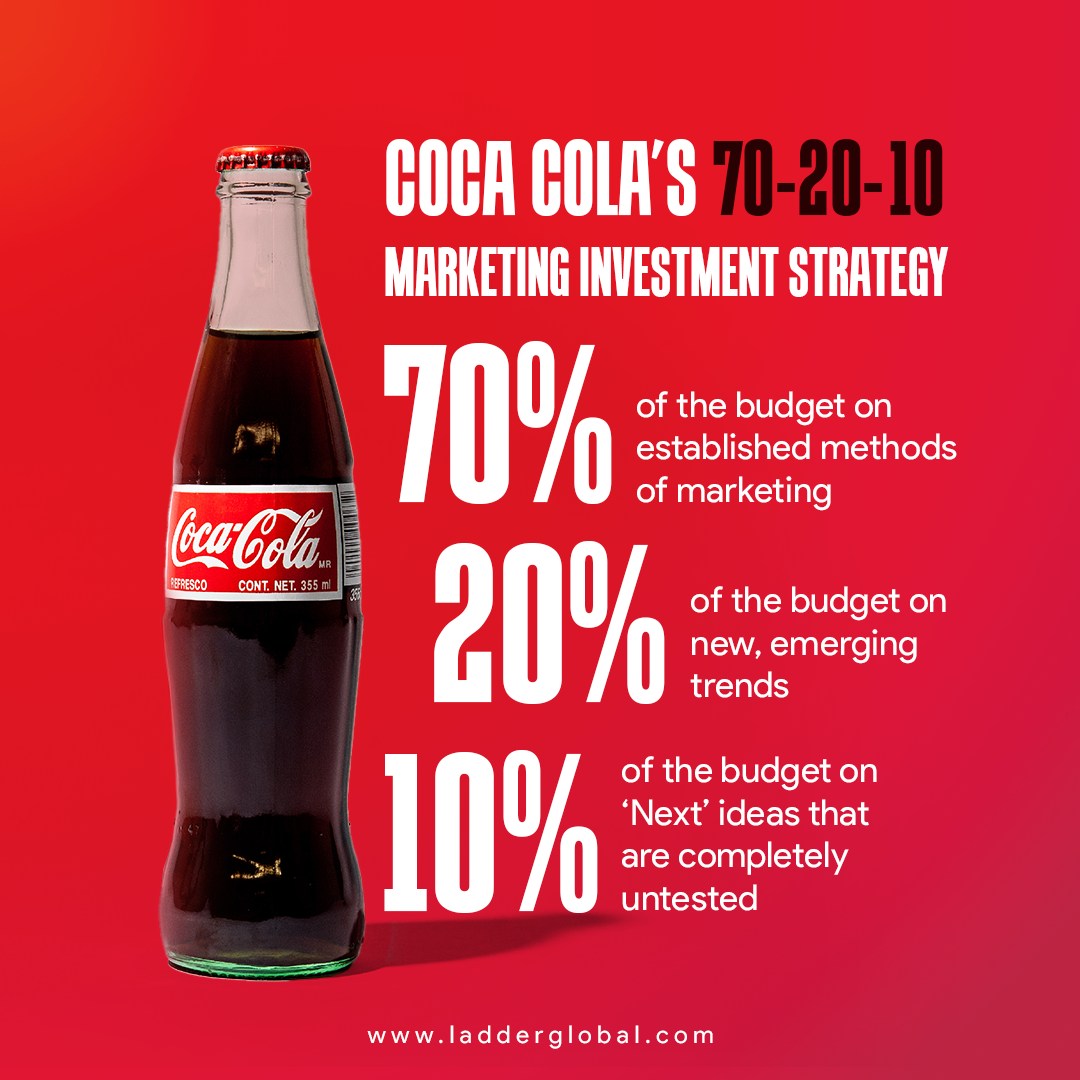
The 70 20 10 rule divides your marketing budget, time, or resources into three buckets:
-
70% — NOW (core). Goes to proven channels and tactics that consistently deliver results — the campaigns, content, and channels you know work because you have the data to prove it.
-
20% — NEXT (emerging). Goes to channels and tactics showing early promise but not yet proven at scale. These are calculated bets on ideas that could become part of your core strategy.
-
10% — NEW (experimental). Set aside for completely new, untested ideas. This is your innovation budget — the space where you try things that might fail spectacularly or become your next big channel.
The framework forces structure around innovation. You protect your core revenue while systematically exploring what comes next.
How the 70 20 10 rule is used
The 70 20 10 rule has been adopted independently across three very different contexts. The ratios are identical but the underlying logic differs in each case.
| Context | 70% | 20% | 10% | Key source |
|---|---|---|---|---|
| Marketing budget | Proven channels (SEO, paid, email) | Emerging channels with early signals | High-risk experimental ideas | Coca-Cola Content 2020 / Jonathan Mildenhall |
| Engineering and innovation | Core business (search and ads) | Emerging products built on the core | Completely new ideas | Google / Eric Schmidt, How Google Works |
| Learning and development | On-the-job experience and real challenges | Coaching, mentoring and feedback | Formal training, courses and structured programmes | Center for Creative Leadership |
Where does the 70 20 10 rule come from?
Several major organisations adopted the 70 20 10 model independently, most notably Coca-Cola and Google.
At Coca-Cola, Jonathan Mildenhall, then Vice President of Global Advertising Strategy and Creative Excellence, championed the framework as part of the company’s Content 2020 strategy. Mildenhall talked about “liquid and linked” content — content so compelling it spreads across the web — and 70 20 10 was the investment model behind it. Seventy per cent went to low-risk proven formats, twenty per cent innovated on what was working, and ten per cent went to high-risk new ideas.
At Google, Eric Schmidt and Jonathan Rosenberg described the same ratio in their book How Google Works (2014). Google applied 70 20 10 to engineering resource allocation: seventy per cent on the core business (search and ads), twenty per cent on emerging products built on that foundation, and ten per cent on completely new ideas. Gmail and Google News both emerged from that ten per cent. This connects directly to Google’s 20% time policy, where engineers were encouraged to spend one day a week on self-directed projects.
“70/20/10 became our rule for resource allocation: 70 percent of resources dedicated to the core business, 20 percent on emerging, and 10 percent on new.”
Eric Schmidt and Jonathan Rosenberg, How Google Works
Why the 70 20 10 rule works
The framework works because it addresses the two most common failure modes in marketing resource allocation:
Failure mode 1: All core, no innovation. Teams that put one hundred per cent into proven channels feel safe in the short term but slowly lose ground. Channels saturate. Audiences shift. Competitors find new approaches. Without a deliberate allocation for experimentation, you are always reacting rather than leading. Andrew Chen describes this as the law of shitty clickthroughs — every channel declines in effectiveness over time.
Failure mode 2: Too many bets, no focus. Teams that spread resources across dozens of unproven initiatives never invest enough in any one of them to get a meaningful signal. You end up with a pile of half-tested ideas and no clear winners.
70 20 10 avoids both traps by:
- Protecting your revenue base with the seventy per cent allocation
- Creating a pipeline of emerging opportunities in the twenty per cent
- Giving explicit permission to experiment (and fail) with the ten per cent
- Providing a clear path for ideas to graduate from NEW to NEXT to NOW
This is closely related to how teams think about the long and short of it — balancing short-term performance channels with longer-term brand and innovation investment.
How to implement the 70 20 10 rule in your marketing
Step 1: Audit your current allocation
Before applying the framework, understand where your resources go today. Most teams are surprised to find they are spending ninety per cent or more on core activities and almost nothing on experimentation. Map your current channels, campaigns, and projects into the three buckets.
Step 2: Classify your activities
Go through your current marketing activities and categorise each one:
-
NOW (70%) — Channels with six or more months of positive performance data. You know the unit economics, you have benchmarks, and you can forecast results with reasonable confidence. Examples: established SEO content, proven paid acquisition campaigns, high-performing email sequences.
-
NEXT (20%) — Channels or tactics with early positive signals but not yet enough data to call proven. Examples: a new content format that has worked in a few tests, a paid channel where early campaigns show promise, a partnership that is generating initial leads.
-
NEW (10%) — Ideas with no performance data. You are testing a hypothesis, not optimising a known channel. Examples: experimenting with a completely new platform, testing a radically different positioning, trying an unconventional content format.
Using a structured marketing channel strategy alongside the 70 20 10 rule helps you map which channels belong in each bucket and decide where to focus next.
Step 3: Set review cycles
The real power of 70 20 10 is movement between buckets. Set a regular cadence — monthly or quarterly — to review what should graduate:
- NEW ideas that show promise move to NEXT and get more resources
- NEXT ideas that prove out move to NOW and become core
- NOW activities that decline get reduced or cut
- NEW ideas that fail get documented (learnings captured) and replaced with new experiments
Step 4: Protect the ten per cent
The experimental budget is the first thing to get cut under pressure. Treat it as non-negotiable — it is your insurance against long-term stagnation.
The 70 20 10 rule in learning and development
Outside of marketing and innovation, the 70 20 10 rule is one of the most widely cited models in learning and development. In this context, the split describes how professionals actually learn, rather than how to allocate a budget.
The model was developed by researchers at the Center for Creative Leadership, based on interviews with successful executives. The core insight was that professional development does not happen primarily in classrooms or training programmes:
-
70% — Learning by doing. The majority of development happens through on-the-job experience: real challenges, stretch assignments, projects outside your comfort zone, and learning from mistakes in real work situations.
-
20% — Learning from others. A significant portion comes from social learning: coaching from a manager, mentoring from a senior colleague, peer feedback, and observing how effective leaders operate.
-
10% — Formal learning. Only a small fraction comes from structured training programmes, courses, workshops, and formal instruction.
This model has significant implications for how organisations design development programmes. If ninety per cent of real learning happens outside of formal training, then investing disproportionately in courses and workshops produces diminishing returns. The most effective L&D strategies create conditions for on-the-job stretch, structured feedback loops, and formal training only where it reinforces the other two.
The L&D version of 70 20 10 is also a useful lens for marketing teams building capability. If you want your team to get better at a new skill — say, data analysis or video production — formal training is only a small part of the answer. Real growth comes from giving people real projects that require the skill.
Common mistakes
Treating the ratios as rigid rules. The exact split matters less than the principle. For a startup with no proven channels, a 50-30-20 split might make more sense. For a mature enterprise, 80-15-5 might be appropriate. The point is to allocate deliberately across all three categories.
Failing to graduate ideas. Some teams run experiments in the ten per cent bucket but never move winners into NEXT or NOW. The result is permanent “innovation theatre” that never impacts the core business.
Skipping the audit. If you do not know where your resources currently go, you cannot apply the framework. Start with the audit.
Cutting experiments when budgets tighten. When budgets get squeezed, the first instinct is to cut the experimental ten per cent. This is a mistake — tight times are exactly when you need to find the next efficient channel, because your existing channels are likely getting more expensive.
No learning system. The value of the ten per cent is not just the experiments that succeed — it is what you learn from every experiment, including the failures. Without a system for documenting and sharing those lessons, each experiment starts from scratch. We cover this in more detail in our guide to building a culture of experimentation.
Measuring success across the three buckets
Each bucket needs its own metrics and expectations:
| Bucket | Metrics | Expectation |
|---|---|---|
| NOW (70%) | Revenue, ROI, CAC, conversion rate | Consistent, predictable performance |
| NEXT (20%) | Early indicators: engagement, pipeline, cost-per-lead trends | Improving trends, not yet at scale |
| NEW (10%) | Learnings per experiment, hypothesis validation rate | Most experiments will fail — measure learning velocity |
The mistake most teams make is applying NOW metrics to NEW activities. If you judge experimental campaigns by the same ROI standards as your proven channels, nothing will ever graduate.
For deciding which experiments to fund in the first place, prioritisation frameworks such as ICE, PIE, and RICE give teams a consistent way to score and rank ideas before committing budget.
Final thoughts
The 70 20 10 rule is not a magic formula. It is a thinking tool — a way to make sure your team deliberately balances doubling down on what works with exploring what might work next. Whether you are applying it to a marketing budget, an engineering team, or a learning and development programme, the underlying logic is the same: protect your core, invest in emerging opportunities, and always keep a slice for genuine experimentation.
Growth Method is the only work management platform built specifically for growth teams, combining ideation, experimentation, and analytics in one platform. Book a call to learn more.